 |
Suisun Wildlife
Center - Wildlife First Aid Tips
Monique Liguori, Executive Director |
Wildlife First Aid Tips
Throughout the year we receive many calls from people with various wildlife concerns and problems. Many of them can be handled simply with the right information and do not always require the intervention of the Wildlife Center. Here we will attempt to discuss some of the more common questions and problems.
 How to avoid some common wildlife problems
What to
do if you find an injured or orphaned wild animal
BABY
BIRDS
FAWNS
JACKRABBITS
OPOSSUMS
SNAKES
SKUNKS
RACCOONS
Which
animals we can't accept
Back to
Suisun Wildlife Center Home Page
Most problems with wildlife around homes and businesses can be solved without incurring expense to have animals removed, which legally cannot be done in the State of California unless they have caused property damage. In many cases animals will die as a result of removal if trappers do not use humane methods and make every effort to keep babies with mothers. If you feel you MUST use a licensed trapper, we recommend: Ron Bailey, Animal Capture & Removal, (707) 678-8604. If you use another trapper, ask questions! Ask what will happen to animals if they are trapped and removed, and what alternatives might be possible. Make sure you are aware and comfortable with the service you will be paying for, and remember that situations like mothers with babies are usually short-term.
Many problems can be avoided by not attracting wildlife in the first place. What do they come for?
Food – One of the biggest attractants for wildlife is feeding other animals, especially feral cats. Most animals that frequent yards are nocturnal, including opossums and raccoons. Bring in all pet food at night. Excess fruit or vegetables from trees or gardens should be cleaned up. If you have bird feeders, feed in the morning and try to give only what will be consumed that day. Make every effort not to make food sources available.
Shelter – If there are openings into a house, garage or other buildings, animals will sometimes seek shelter there, including while nesting. Again, if they have not caused property damage they can’t legally be removed, and if there are babies the best thing to do is to wait the short period of time until the babies are raised, when the mother will take them and leave. If there are no babies, a good way of getting animals to leave is the “light-sound” method, where you light up the area (basement, foundation, attic) at night with a shop light and turn on a loud radio. Give them time to leave! With either method, once you are sure the animals have left you need to block any access to the area to prevent them from returning.
You are the eyes and ears who are first to find and aid injured and orphaned wildlife!
However, if you find a baby of any kind - PLEASE (!) fight the urge to jump in and rescue it immediately! The mother may be off feeding and will return given time. Even baby squirrels that have fallen or been in a tree that was cut down can be returned to the mother through use of a rescue box. So unless you are certain that the mother has been killed, please - for the sake of the animal or bird - allow time for the baby to reunite with the parent. If you have any doubt, call us first for advice.
If you do find an injured or orphaned wild animal or bird and - after having reviewed all of the items below - you decide to bring the animal to the Wildlife Center, the following procedures should be followed.
-
Approach and handle any wild animal with extreme care. You could be injured more quickly than you think. A heron or egret's beak can cause severe damage. A hawk's talons can go right through your hand, and bites can be dangerous. Try to have a second person on hand as backup. For large animals, skunks and bats, do not attempt to handle - call Solano County Animal Control (707) 421-7486, or the nearest humane society in your area of Solano County.
-
Use a towel or blanket to toss over and cover it - and place it quickly and gently in a cardboard box. Always use gloves, especially with mammals and large birds - and a firm, confident grip. Protect your eyes!
-
Try to keep it as quiet as possible, and in a dark place (box), to decrease stress before and during transporting. Do not attempt to feed it - and always bring it in as quickly as possible.
-
PLEASE (!) Do not attempt to care for the animal yourself. The law prescribes that wild animals are to be rehabilitated in licensed facilities only. Many animals come to us malnourished by improper food and treatment. This can happen very quickly - especially with birds - and some animals subsequently die or are unreleasable. Some species of wildlife can carry zoonotic diseases transmittable to humans.
-
Save yourself from the heartache of causing harm and do the right thing for the animal. Bring it in as quickly as possible. If you'd like to help care for wildlife, perhaps you'd consider joining the Wildlife Center as a volunteer.
The Suisun Wildlife Center is open daily from 9:00 am to 6:00 pm in summer and 9:00 am to 4:00 pm in winter. If you have found a wild animal that is in need of our assistance during off hours, follow the above procedures and keep the animal in a warm, dark and quiet place until morning, then call Animal Control, your nearest humane society, or the Wildlife Center during the above hours.
In an emergency, you can call the NON-EMERGENCY phone # for your local police and they will contact the appropriate agency to assist you.
If you have any other questions or problems, please call us at the Wildlife Center - we're here to help.
We appreciate the assistance and concern of the public and our members!
The Suisun Wildlife Center, is permitted
by the California Department of Fish and Game and the U.S. Department of Fish and Wildlife,
and conducts its functions according to the guidelines contained in these permits.

-
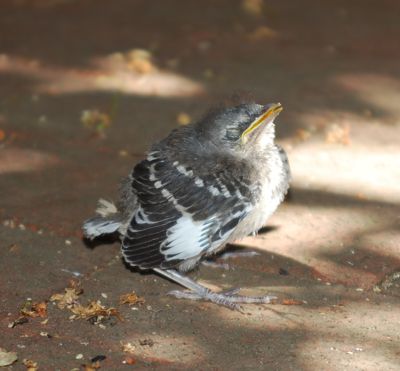
Baby birds are found by the public in great numbers and in all stages of development. One common cause for this is during periods of high winds when nests are blown down or birds fall from them.
Another high-risk time for birds is when they become large enough to first leave the nest. Many cannot yet fly and perch on branches in the nest tree or bush, where the parents continue to feed them. We call these birds "branchers", and the potential for them ending up on the ground is obvious.
If the birds are uninjured, the best course is to try to replace them. The parents will continue to care for them - they are the real experts. Look for the nest, or if it has fallen, see if it can be put back. If the nest is destroyed, you can replace it with a small box or basket with a few tissues inside, fastened to a branch in the shade. This will cause much less distress to both the parent birds and the babies than it would to remove them.
With the "branchers", it may not be possible to find a nest, so they can be placed in a bush or tree in the shade about 5-6' from the ground to remove them from the vicinity of dogs and cats. "Branchers" are older fledglings, fairly well feathered and around 3/4 the size of adults. They may have to be replaced a few times, but this stage passes quickly.
Of course, if you can see or suspect that the babies are injured, then they should be brought to the Wildlife Center as quickly as possible. Check the legs and wings for any sign of breaks, and the neck for any abnormal twisting. If you are uncertain or have any questions, please call the Wildlife Center, our volunteers can advise you.
- ...Return to Top
-
- FAWNS
-
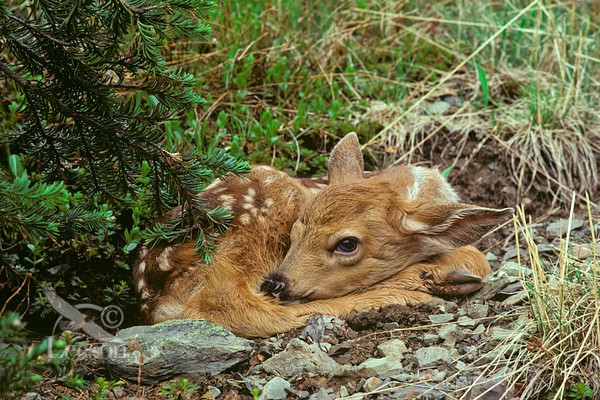
Baby deer are particularly appealing to most people, which creates special problems for them. Most people, upon discovering a fawn, immediately assume it needs to be rescued, which is not usually the case. The doe leaves her baby in one spot while she goes out to feed, where it is protected by stillness and camouflage coloration, its primary protection. If you leave the fawn alone, its mother will return to care for it.
Never remove a fawn unless you are absolutely sure the mother will not return to care for it, for example, if she is hit by a car or missing for more than one day. Fawns are difficult to raise in captivity and it must NOT be done by you at home. For one thing, their diets are very specialized. Wild animals can only live on food natural for their species. Do not ever attempt to feed a fawn cow's milk or anything else. Immediately get the fawn to the nearest wildlife center, which will have a suitable diet replacement on hand.
- ...Return to Top
-
- JACKRABBITS
-
Jackrabbits are another animal whose apparent helplessness makes them a target for uninformed "rescuers". This helplessness is far from real, however. The babies are what is called "precocial", as in precocious, or unusually advanced. They are born with eyes and ears open and all their fur, and begin to move from place to place with the mother soon after birth.
Jackrabbits share many similarities with fawns. The mother leaves them to feed, where they are protected by camouflage coloration. Their diet is also very restricted, and they should also be brought quickly to a wildlife center only if it is absolutely necessary. They require especially careful handling as they are likely to injure their backs in struggles to escape. Complete containment of the body and limbs in a towel or the hands is the best way to restrain them.
So far we've looked at some of the baby animals people commonly encounter in the spring. Now we'll discuss some of the common wild animals that live around us, and provide information on living peacefully with them.
- ...Return to Top
-
- OPOSSUM
-
The odd-looking Opossum, or possum, is an animal people often see and are unnecessarily alarmed by in their yards. Their long nose, gray fur, and long naked tail gives them an almost prehistoric appearance. Possums are rather primitive animals, being marsupials, or pouched mammals, with the babies born very small and growing for some time in the mother's pouch - with opossums the only marsupial found in the United States.
Possums are actually fairly mild-mannered, and scavenge the bulk of their food rather than hunt for it. That is when most people see them, when they enter yards at night to eat pet food, garden vegetables or other food items. Eliminating these food sources from your yard will discourage their presence. They may also hide somewhere in your yard or garage to wait for night, since they are nocturnal.
Opossums are fairly harmless animals, but pets should be kept away from them and, as with all wildlife, they should never be cornered or attempts made to handle them unless absolutely necessary. Review how to avoid problems for more tips.
- ...Return to Top
-
-
SNAKES
-
Many people have the wrong idea about snakes. In reality, the large majority of them are harmless, gentle creatures that provide valuable service in controlling rodent populations around our farms and homes.
The snakes most likely to be seen in our area are garter snakes and gopher snakes, both harmless. King snakes and rattlesnakes are encountered much less frequently. The gopher snake's superficial resemblance to the rattlesnake often creates problems for it, but they can actually be told apart fairly easily. Although the gopher snake will vibrate its tail, it has no rattles, the unique property of the rattler. The gopher snake also has round pupils in its eyes like ours, while the rattler's pupils are elliptical, or pointed like a cat's.
The rattler is the only snake to be avoided in California, and this is not difficult. When hiking or climbing, wear boots and avoid placing hands and feet in places where you cannot see. If you should encounter a rattlesnake or any snake, your best course of action is to back off and allow the snake a way to retreat, which they will generally quickly do. Should someone be bitten by what you believe to be a rattler, attempt to kill the snake if this can be done without delay and take it along to aid in identification. Immediately take the bitten person to the nearest hospital, where healthy people usually recover quickly from such a bite with treatment.
Most snakes are harmless and helpful, and should never be killed unnecessarily, as the benefits they provide are considerable.
- ...Return to Top
-
-
SKUNKS
-
At last we come to everyone's favorite animal, the skunk! Seriously, there are many good reasons to avoid contact with skunks. The first reason, and one we are all aware of, is the excellent weapon of the skunk's protective spray. Most of us are all too aware of that defense!
Many of us are not aware, however that skunks will warn before they spray. They do this by stamping their front feet down together, one or more times. That's the time to leave!
Skunks are also one of the few animals to carry rabies, and should especially be avoided if seen in the daytime - since that is not normal behavior for them.
If you have problems with skunks around your home, start with sealing all openings around the bottom of the house, and of course removing all food sources. When property damage is a problem, trapping may have to be considered. Refer to the information on trapping above. If a skunk appears to you to be ill, immediately contact Solano County Animal Control at (707) 784-4733.
- ...Return to Top
-
-
Animals we can't accept
-
We are unable to accept pets of any kind, farm animals including domestic ducks and geese, and specific animals that are controlled by California State Fish and Game regulations. If you are uncertain as to which animals apply, please give us a call at (707) 429-HAWK.
- Summing Up
-
If you decide to bring any injured bird or animal to the Wildlife Center, approach and handle it very carefully. You could be injured more quickly than you think. Use a towel or blanket to toss over and cover it and place it quickly and gently in a cardboard box. Use gloves, especially with mammals and large birds. Protect your eyes. Try to keep it as quiet as possible, and in a dark place (box), to decrease stress while transporting, and always bring it in as quickly as possible.
-
-
Again, if you have any questions or problems, call us first at the Wildlife Center, (707) 429-4295 - we may be able to save you time and trouble!
-
-
PLEASE do not use Email or Facebook to deal with distressed wildlife. Always call the wildlife center closest to you. And please, please, please do not attempt to care for it yourself - we get far too many animals and birds that have been debilitated and malnourished because of a misguided decision. The faster you can get the them into the right hands, the higher the chances for survival.
- If you would like to help more, press here for information.
-
-
-
 Please address any questions
that don't need immediate help to
info@suisunwildlife.org
Please address any questions
that don't need immediate help to
info@suisunwildlife.org
-
Suisun Wildlife Center
Environmental
Education
SMNHA
HomePage
On Line since 1994 © SMNHA
Send Email comments or inquires to:
webmaster@suisunwildlife.org
Information subject to change -
please call or Email for verification.
Last update - (05/30/18)